
macOS
On macOS, freemkv is one binary with two faces: a native desktop app and
the command line. Both run the same engine — the app just opens a window.
Install with Homebrew (easiest)
Section titled “Install with Homebrew (easiest)”brew install freemkv/tap/freemkv # command linebrew install --cask freemkv/tap/freemkv-app # desktop appThis is the path with no friction, and it is the one to use if you just want
the app working. Homebrew fetches with curl, which never marks a file as
quarantined, so the security prompt described below never appears. Everything
else on this page still applies.
”Apple could not verify freemkv” on first launch
Section titled “”Apple could not verify freemkv” on first launch”freemkv is not notarized by Apple yet, so anything you download in a browser — the app and the plain CLI binary — is blocked the first time you open it. The dialog says macOS “could not verify” it is free of malware, and offers only a Done button.
This is not a broken download. Re-downloading will not help. Allow it once:
- Open the app (or run the binary). It refuses — click Done.
- Open System Settings → Privacy & Security and scroll down. There is now a line naming freemkv with an Open Anyway button.
- Click Open Anyway and confirm.
That is a one-time step per download. Afterwards it opens like any other app.
For the CLI you can skip the trip through System Settings by clearing the quarantine flag directly:
xattr -d com.apple.quarantine ./freemkvInstalling with Homebrew, or fetching with curl, avoids all of this: neither
sets the quarantine flag that triggers the check.
The desktop app
Section titled “The desktop app”brew install --cask freemkv/tap/freemkv-app (above) is the recommended way to
get the app — the cask strips the quarantine flag after install, so it opens
immediately with nothing to click through.
If you’d rather have Apple’s own Gatekeeper prompt than trust this tap, the
.dmg (Apple Silicon or Intel) is still on the
All desktop releases page linked from
Download. Open it and drag freemkv.app out — to
Applications, or just your Downloads folder; anywhere works, there’s no install
step. Double-click it, then pick a disc or a disc image, tick the titles and
tracks you want, choose a format, and press Rip.
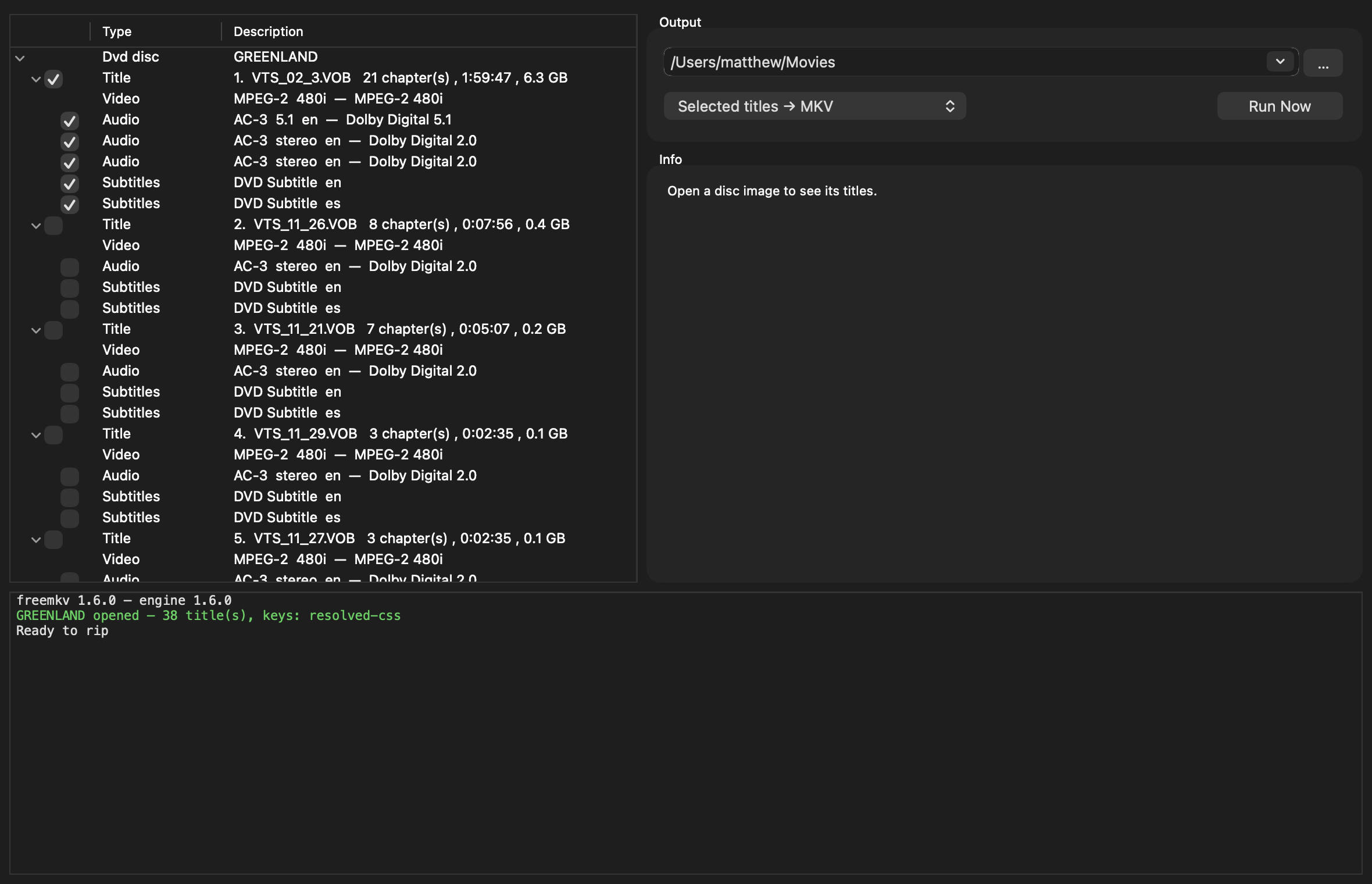
The freemkv desktop app on macOS.
- Open a source with the file picker, or drag an
.iso/.mkv/.m2ts/.mp4straight onto the window. - Per-title and per-track selection with tri-state rollup, an output-format picker that follows the source, live progress (engine speed + ETA), and a copyable log.
- First launch is blocked by macOS until you allow it once — see above.
The command line
Section titled “The command line”The very same binary is the full freemkv CLI. If you installed the app, the
executable lives inside it:
/Applications/freemkv.app/Contents/MacOS/freemkv --versionOr download the standalone CLI binary for macOS (Apple Silicon or Intel)
from the Download page — handy for scripts, brew, or CI:
mv freemkv-*-macos freemkv && chmod +x freemkv./freemkv iso://Disc.iso mkv://Movie.mkvA binary downloaded in a browser is blocked on first run, exactly like the app
— allow it once in System Settings → Privacy & Security, or run
xattr -d com.apple.quarantine ./freemkv. Fetching with curl or Homebrew
avoids it entirely. Each binary has a matching .sha256 checksum on the
release page.
From a terminal, freemkv gui opens the desktop window; any other invocation is
the CLI. See the CLI reference for the full command grammar.
File locations
Section titled “File locations”| What | Path |
|---|---|
| AACS keys | see Decryption Keys |
| Diagnostic log | off by default (see below) |
The CLI keeps the terminal clean and never writes a log unless asked. Run with --log-level 3 to write ./log.txt in the current directory, or --log-file PATH to choose the destination.
Device / drive access
Section titled “Device / drive access”freemkv obtains exclusive access to the optical drive through IOKit. To do so it unmounts the disc first, so the drive is freed for direct reads while ripping. Optical drives appear as /dev/diskN devices.
Known quirks / troubleshooting
Section titled “Known quirks / troubleshooting”- Nothing here is notarized yet, so a browser download is blocked on first launch — see above for the one-time fix, or install with Homebrew and skip it.
- If the disc is mounted by the Finder, freemkv unmounts it to take exclusive access; that’s expected.
- For capturing logs and other common fixes, see Troubleshooting.